
Sell Your House Quickly And Simply
in 28 Days With £0 Fees
If you want to sell your house fast and get the best possible offer, you are at the right place!
Get Cash Offer NOW or Call Julie 0161 258 7486
or Call Julie 0161 258 7486

The last 24 months or so have been a roller coaster for UK house prices, particularly those outside the South East area of England.
My brother lives within that area and presently occupies a 5-bedroom house. All the children have flown the nest and he is now seriously considering downsizing but he would prefer to stay within the area. Yes, there is a fair bit of equity in his property but other prices have also risen and so he is in a bit of a dilemma! This article will show why!
In most parts of the country, prices have been increasing over the past couple of years. In general they have not reached the dizzy heights achieved before the worldwide financial crash.
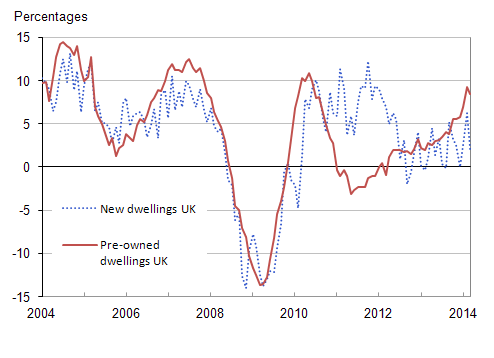
Annual house price rates of change, UK all dwellings from January 2004 to February 2014 (ons.gov.uk)
The graph above clearly outlines the increase in prices from 2004 until the early part of this year and you will notice the growing upwards trend over the past two years.
However, the present indications are that this increase is beginning to slow down, particularly in the areas of the country where there is uncertainty about employment. The main concern of people seems to be the Cost of Living and how it relates to a) interest rates and b) wage increases.
The Base Rate as set by the Bank of England, determines the interest rates charged by banks for mortgages. This has not changed for a number of years but the Governor has indicated that a rise will be due towards the end of 2014 or the beginning of 2015 and so will not immediately have a great effect on the costs of mortgages. However, wages have hardly increased at all but when, not if, a rise in the Base Rate of interest occurs, an increase in mortgage rates will inevitably follow, which will produce a net increase in cost to a mortgagee.
As we all know, the cost of living has steadily risen over the same period and without a corresponding increase in wages, coupled with a potential increase in mortgage rates, people are becoming less inclined to take the gamble and move to a new property.
This is a vicious circle. You see, if people are not prepared to move, then there are less properties coming on the market and as a result, prices rise. This is particularly obvious in the South of England where there is already a natural shortage of properties yet an abundance of potential buyers. So when new ones are introduced to the market, not only do they sell house quickly but they also sell at a high price. This does not apply to other areas of the country.
The more North you move within England, the longer a property will take to sell. People are not moving house so much and therefore there is a shortage of new buyers. This means that in order to sell a property, the vendor will often have to reduce the selling price in order to entice a purchaser to complete the purchase which in turn, results in overall reduction in house prices. This is aptly portrayed in the graph below which outlines the average length of time a property will stay on the market before a sale is achieved.
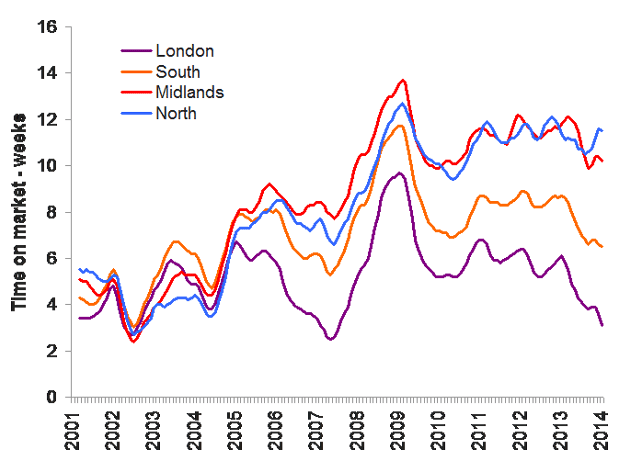
Time on market – aggregated regions (www.moneyweek.com)
There is not an overall agreement by the market as to how UK property prices will react in the forthcoming years. The Centre for Economics and Business Research (Cebr) is of the opinion that whilst it accepts prices has will have risen by some 7.8% during 2014, more than twice the rate of increase than 2013 and the highest since 2007, prices during 2015 will fall by at least 0.8% but then increase on a year-by-year basis of 3%.
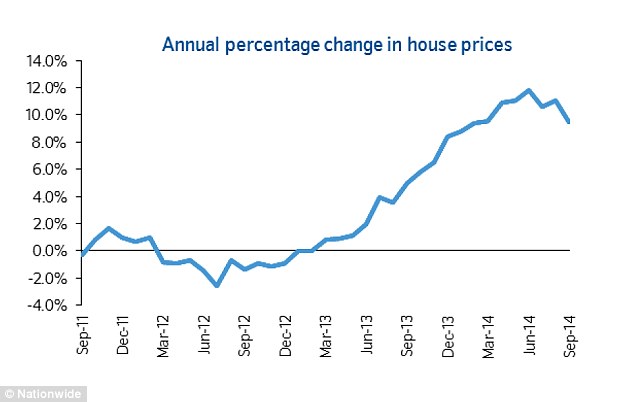
Annual percentage change in house prices (© Nationwide)
However, one of the largest estate agents foresees an increase in property values as high as 26% during 2015. But this particular estate agent deals primarily with large, London based properties and because of the special circumstances surrounding London and the South of England, this may very well be a fair assumption.
In reality, no-one can really say how UK property prices will react in the future. This current year we have seen both ebbs and flows. We have seen the London average house price break the £500,000 barrier, yet the average price for properties in Northern Ireland and Wales is just over 20% of this value.
There are two inevitabilities: wages will not increase significantly but in the forthcoming year, there will be a rise in interest rates. Many sellers are playing a guessing game with themselves. “Should I wait a bit longer and hope for another small rise before I sell?” The indications are that this rise will not come about during the remainder of this year nor in the early part of 2015. If they do not sell soon, they will have “missed the boat” so to speak.
However in order to purchase a new property, an owner needs to sell their existing one in the first place and this is where the big dilemma occurs. You see, everything is relative!
My own personal views are these and whilst I am not an expert in the field of property prices, I am a very keen observer.
First of all, I consider London to be in a world of its own. There is an abundance of international buyers for any type of property in the area and whilst that demand exists, prices will continue to rise. Mortgages may well start to become beyond the reach of the average person but international buyers normally have cash available and do not rely on the banks. What I believe will happen in the future is that people will start, during 2015, to move away from London into the outer regions; to areas where they can afford UK property prices. Some will, either through choice or necessity, start moving to the Midlands and North of England which will start to create a demand for property.
Businesses are starting to seek cheaper areas in which to operate and with their move come their staff. This will encourage property sales in the North and along with it, an increase in property prices.
If you need to move quickly and are experiencing difficulties in selling your property, please contact us as we may well have the solution to this problem.
References:
 Ryan has worked in many areas of property over his eight years in the business. From Lettings to Property Management to New Home Sales to Investment, his knowledge and passion are second to none. He is currently based in Nottingham.

We treat your information with care in accordance with our data protection licence.
GENUINE PROPERTY INVESTMENTS LIMITED is registered with the Information Commissioner's Office under registration reference: A8037450.